Method for Determining Polybrominated Diphenyl Ethers Using a 7800 Hyperbolic Quadrupole Mass Spectrometer
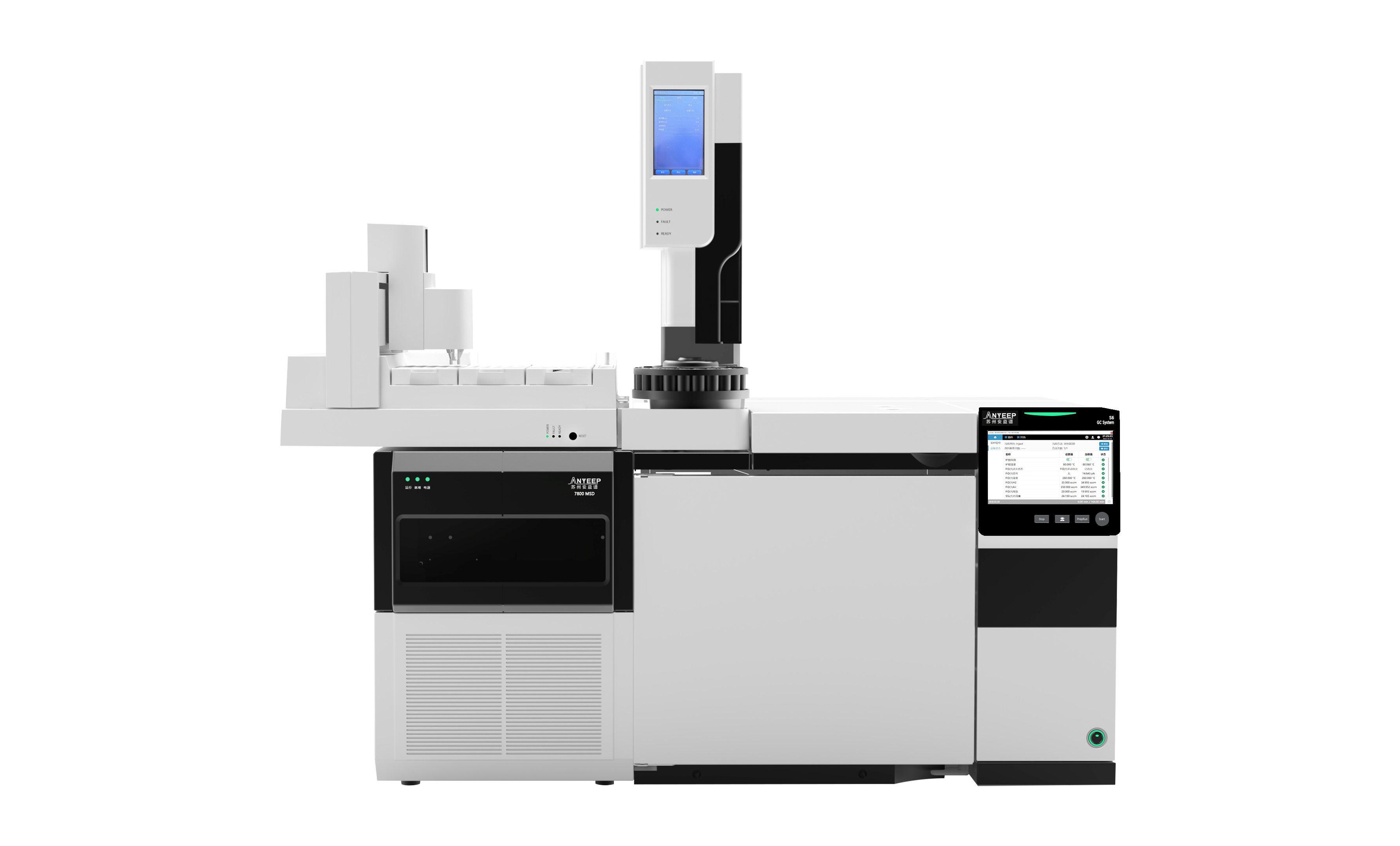
Referencing GB/T 26125-2011 for the determination of six restricted substances (lead, mercury, cadmium, hexavalent chromium, polybrominated biphenyls, and polybrominated diphenyl ethers) in electrical and electronic products, we adopted a scan mode to qualitatively analyze polybrominated diphenyl ether standards based on retention time, mass spectra, and characteristic ion pairs. We optimized key parameters including injection port temperature, temperature programming, injection method, and ion source temperature. A calibration curve was established using Selected Ion Monitoring (SIM), and the repeatability of the results was evaluated. Ultimately, we developed a method for determining polybrominated diphenyl ethers using the Anyspec 7800 hyperbolic quadrupole gas chromatography-mass spectrometry system.
Experimental Conditions
gas phase conditions
Injection mode: pulsed splitless; pulse pressure: 20 Psi; pulse time: 0.75min; purge flow: 50mL/min;
Purge time: 1 min; Carrier gas flow savings: 15mL/min; Carrier gas time savings: 4 min; Inlet temperature: 280°C; Injection
Sample volume: 2 µL; Column: DB-5HT 15 m × 0.25mm × 0.1 µm. Constant flow mode: Column flow rate: 2mL/min; Column
Box heating program: 100°C (1 min) 30°C/min 340°C (5 min)
Mass Spectrometry Conditions
Ion source temperature: 350°C; Transfer line temperature: 340°C; Solvent delay: 2 min;
Tuning conditions: Ion source tuned at 350°C; all fragment ion intensities and ratios meet standard requirements.
Multiplier Voltage: Use a multiplier voltage that meets the above tuning requirements.
Scan modes: Full scan (SCAN) and Selected Ion Monitoring (SIM);
SIM Group:
2.00~6.9 0 min 141.1, 168.1, 246.0, 248.0, 250.0, 325.9, 327.9, 403.9, 405.8, 407.8,
483.7, 485.7, 563.7, 565.7, residence time 20ms; 6.90~14.00min 320.8, 359.7, 483.8,
561.7,563.7,641.5,643.6,645.6,719.4,721.6,799.3,801.3,801.4,879.3,959.1,
Residency time 20ms.
Experimental Results
Prepare PBDE standard solutions at 5-500 ng/mL (monobrominated to nonabrominated: 5-500 ng/mL; decabrominated: 50-500 ng/mL). Analyze by instrument. The linear correlation coefficient exceeds 0.995, indicating excellent linearity. Prepare samples at different concentrations (100, 200, 300, 500ng/mL). Analyze each concentration in 6 replicates and compare retention times and peak areas. Table 1 lists the relative standard deviations (RSD) of peak areas and retention times for 6 replicate measurements across all concentrations. The RSD of peak areas ranges from 0.64% to 9.58%, while deviations in retention time are minimal, demonstrating excellent instrument repeatability.
This study establishes a method for determining polybrominated diphenyl ethers using the AnYiPu 7800 hyperbolic quadrupole gas chromatography-mass spectrometer. The method demonstrates excellent linearity and reproducibility, meeting all standard requirements.